Baby Led Solids: Research & Experiments

Baby Led Solids: Research & Experiments

all content copyright protected
Baby-led Solids Twitter Button
Showing posts with label vegetables. Show all posts

Quesadilla

Although your baby doesn't need teeth to effectively implement the baby-led solids method, there are times when they can be quite serviceable. I tried quesadillas a few months ago, before Buttercup had teeth, and it didn't go over too well. She tried a piece, spat it out then ignored it. 


Recently I made a quesadilla for my own lunch, and gave some to Buttercup. It was made with whole wheat tortillas, spinach, cheese, garlic and cumin. I cut it into little Buttercup-sized squares. She was much more interested now that she's got a few teeth. I've found she uses them to clamp on food while she pulls on it with her hand. Whatever works!


She definitely preferred the tortilla to the cheese. Whenever the melted cheese would squish out the sides and fall on her tray she would pick it up and try it, but spit it back out again. 


PROS: good and easy multiple-food-group meal
CONS: teeth make this food more manageable

Green Pepper, take 4

One morning as I was cutting a green pepper Buttercup tootled into the kitchen. Upon seeing the pepper she begged me for it, so I plopped her in her chair and gave her a slice for her very own. She only ate half a slice at this sitting, but she has gleefully eaten these again since. It does seem as if she prefers red peppers to green ones, though. 


This has been an interesting food to watch Buttercup eat along her evolutionary eating path. The first time I gave her pepper she wasn't interested at all. I think this is due to the fact that she was toothless and unable to do anything but suck on it.  For quite some time Buttercup ate her peppers either lightly steamed or as part of a cooked entreĆ©. This worked better since Buttercup was sans teeth until 10.5 months. Now she is able to use her little teeth to scrape and bite the pepper.


It's nice that Buttercup is able to enjoy more foods raw now. This means less work for me and more nutrients for her!


PROS: still high in vitamin C
CONS: some tools required (teeth)

Omelette

Recently I made breakfast for dinner: omelettes with egg, mushrooms, spinach, green onions and cheese, leaving Buttercup's portion salt-free. I cut the omelette into little squares for easier pick-up-ability. 


Buttercup liked it. It wasn't her favorite meal of all time, but she ate it happily enough.


We used to limit Buttercup's intake of egg whites, due to family history of egg allergies and also eczema that was worsened by egg consumption (both via breastmilk and eaten directly). I am happy to report that Buttercup's eczema has drastically improved. I know most babies outgrow this annoying skin condition eventually, but it makes me happy not to have to factor a skin reaction into my meal decisions.


PROS: protein + veggies = healthy combo
CONS: Buttercup prefers other dishes

Mushroom, take 2

I've said it before, but if your baby rejects a food don't be afraid to keep retrying it down the road. For example, a few months ago Buttercup didn't care for raw mushrooms. But, the other night I was cooking dinner and a sliced mushroom landed on the floor near where Buttercup was playing. It promptly went into her mouth. And, she "asked" for more of it! 

So, there you have it: a previously rejected food is now a yummy treat.

Spinach

I can never decide what my favorite thing about baby-led solids is. Some days it's the simplicity of it - how I never have to buy or make purees and spend time spooning food into my baby's mouth. Sometimes it's the fact that my little baby eats things like curry, fish, or gjetost. And, sometimes it's the fact that my baby's diet mainly consists of fresh, healthy foods and she loves it! 


Whilst making myself a sandwich one day I threw a couple of my spinach leaves Buttercup's way. I didn't really expect her to do much more than play with them. But, being the omnivore she is, she ate them. Seriously, this kid will eat anything. This has its downfalls, especially when she's playing on a not-freshly-vacuumed floor or outside, for example. One of Buttercup's favorite non-foods is paper. She loves tearing apart and chewing on paper. While I don't endorse paper as a good food for babies (and feverishly try to prevent Buttercup from eating it), I guess all of her practice at eating books paved the way for her to successfully enjoy spinach leaves. HA HA!


Buttercup has had cooked spinach mixed into dishes before (and blended into her smoothies), but this was the first time she ate raw spinach. She tore the little leaves apart and ate them much in the same way she eats every little piece of paper she can get her hands on. I was curious how she would deal with the spines, but she ended up tearing the leaves off the spines, and left the spines alone. I was also interested to see if Buttercup would gag on little bits of leaf getting hung up in her throat. While she did cough a few times, she didn't have any problems with it. However, I wouldn't recommend this to babies just starting down the baby-led solids path. Also, I suggest buying organic spinach, as spinach is one of the "dirty dozen."


PROS: great nutritious superfood, no prep
CONS: not for the BLS newbie


***UPDATE: The evening I posted this we gave Buttercup raw spinach leaves again. She coughed a lot more than she did the first time. So, I guess I'm saying "be careful."***

Thai Curry (baby corns, bamboo)


We continued with our curry theme and introduced Buttercup to the wonderful world of "jungle mixed vegetables curry" from our local thai restaurant. It is my favorite and I order it every time (after all, why try something else when you already know what the best thing on the menu is?). Check out the menu description: 

I ordered it with the tofu, and while I obviously didn't give Buttercup any of the cashews (hello, choking hazard), I did give her everything else. It was Buttercup's first experience eating baby corns and bamboo shoots, and she adored the baby corns. I always thought baby corns were just a fun-looking filler, but it turns out they are actually quite good for you. They are a good source of folate, vitamin B and fiber, and are also rich in several other nutrients such as potassium, vitamin B6, riboflavin, vitamin C. Plus, there is something about a baby eating baby corns that is extremely cute. Try it - you'll agree.


I think Buttercup particularly enjoyed the variety this meal afforded her, which is exactly why I like it. Well, sorry to cut this short, but I've gotta go and place an order for lunch now... 


PROS: nutritious veggies
CONS: none

Smoothie

I have a wonderful friend who gives her kids smoothies to sneak extra fruits and veggies into their diets.
It's really a brilliant idea, and one I tucked away for future use. Well, the future is now. I made myself a 
strawberry, banana, OJ and homemade yogurt smoothie the other day to use up a browning banana. I poured some into Buttercup's shot glass to see what she'd do with it. Well, she drank it, of course! In fact, she wouldn't even let go of the cup.


This was the first time Buttercup has ever liked yogurt. I'd like to ascribe that to my awesome yogurt-making ability, but I just don't know. By the way, making yogurt is a great way to use up the 52,000 gallons of milk WIC gives you a month, and it's super easy to do. Here is a link to a some good instructions: Modern Alternative Mama Blog. 


Since Buttercup has decided to officially drop her 4:00 nurse, I've been giving her an afternoon smoothie instead. I throw in a banana, half an avocado (makes it creamy), a handful of spinach leaves, some frozen fruit (great way to use up those sour strawberries), some OJ and some homemade kefir or yogurt. She will drink 1.5 to 2 ounces.


PROS: great way to get extra nutrients in your baby
CONS: parental vigilance required if giving baby a smoothie in a cup 

Bell Pepper, take 3

Variety is the spice of life, or so they say. I like to try different foods with Buttercup, and I like trying old foods new ways. She's had bell peppers before, but this time she had them roasted. I'd made roasted red pepper and potato soup (with kale), so I drained the liquids and gave Buttercup the chunks from the soup. Of all of the foods on her tray she went for the red peppers the most. I don't know if it was because she thought they were the tastiest, or if it was because they were most brightly colored. I have noticed she tends to gravitate towards brightly colored foods. I'm sure there's some natural instinctual lesson to be learned here...not sure what it is, though...I do know that brightly colored foods make for brightly colored diapers!

PROS: high in vitamin C 
CONS: none

Veggie Burger

I'm sure other babies would love hamburgers, but I don't eat red meat which means that Buttercup doesn't get hamburgers. I do love a good veggie burger, though. Morningstar veggie burgers are my current favorites. They're great because you can stick them in your toaster and they're done super quick! And, check out these ingredients: mushrooms, water chestnuts, onion, carrots, green and red bell peppers, black olives, brown rice, and rolled oats. I cut a patty into squares for Buttercup and gave them to her for lunch.

For some reason, she tossed it overboard first, the little stinker. After she realized it was actually her lunch she ate it like it was going out of style. In fact, she can eat a whole patty! She loves her veggie burgers just like Mommy and will even beg for more if she runs out. 

PROS: great, easy, source of protein and veggies!
CONS: a bit high in sodium

Parsnip


Parsnips are my favorite thing about British cuisine. Ok, well, maybe chocolate is. But still, the first time I had a parsnip I felt like I was eating manna from heaven. Buttercup recently tried this wonderful root vegetable  as a component in a "vegetable cobbler" that included pumpkin. The parsnips were cut in one inch chunks and roasted with some other veggies before being topped with gravy and a savory crumble topping. 

Buttercup ate the parsnip, but was much more interested in the pumpkin she was offered. I think it may have been a bit hard/chewy for her. So, maybe she will enjoy them more when she's got some teeth. Or, maybe she just really likes pumpkin?

Did you know that parsnips are a great source of vitamin C and folate, which help keep those winter colds at bay, and it's also full of fiber. Did I mention they are darn tasty? 

PROS: taste great, nutritious, non-staining
CONS: a bit chewy

Pumpkin

It literally causes me pain to see rotting jack-o-lanterns  on the curb. I cannot handle it. Call me thrifty, call me cheap, but do not call me wasteful. Last year, Hubby and I rescued 16 abandoned pumpkins. And we ate them. All of them. Pumpkins are such a gigantic, yummy, nutritious food that it's a shame to throw away them away just because you've carved a face on them. Because of our fanatical pumpkin beliefs I have accumulated quite the collection of pumpkin recipes. So, the day after Halloween our beloved Jeffrey the Jack-o-lantern was unceremoniously hacked to 1-inch pieces and frozen to await his rebirth as our future meals. One of those meals is our family favorite, the "Vegetable Cobbler." 

Basically, it's a bunch of roasted veggies with some gravy and a crumbly topping. So, Buttercup had her first taste of pumpkin. She's always been a big fan of squash in general, and pumpkin proved no exception. She gobbled it up, begged for more, and ate that, too.

Sidenote: do not give your infant pumpkin seeds. They require much chewing with molars. I thought that seemed obvious, but I was actually asked on a forum a few weeks ago if it was a good snack for babies. Uh, no.

PROS: great texture and nutrition
CONS: labor-intensive, especially if you buy big pumpkins.

Broccoli, take 2

Persistence and imagination are the keys of successfully feeding babies. If you think your baby "doesn't like" a food, just keep trying to give it to her in new ways. 

I've noticed that Buttercup has lost interest in lots of foods that are presented in the classic BLS "french fry" shape. This means she is suddenly blasĆ© about former food favorites. She'll put the whole thing in her mouth then spit it out after a few minutes. Buttercup is still eating little pieces of food with much vim and vigor, so I decided to mix things up a bit. I've been giving her previously rejected foods with a fresh presentation. For example, I tore some broccoli florets into smaller chunks suitable for picking up with thumb and forefinger. It meant a bit more work for me than how I used to give her broccoli, but it was worth it because Buttercup ate tons more of it than she has in quite awhile. Here I thought she didn't like broccoli anymore, but it turns out she just didn't like the method in which I was serving it. I should have known better! Iron-packed food in fun bite-sized pieces!

PROS: easier for older baby to eat
CONS: a bit more prep work involved

Chili


Baby-led solids is so much fun. Really! I love that my baby eats the same things I eat. I love that she gets so excited to feed herself. I love that she is learning different foods, flavors, and textures. I love sitting down for meals as a family. No pursed lips to my incoming spoon. Just. Eating. 

Buttercup recently tried chili for the first time. My chili is heavy on the beans and veggies, mild-medium on the spice level, and vegetarian (we use Morning Star crumbles in place of ground beef). Buttercup has also eaten grandma's chili, which is more meaty (ground turkey) and less veggie-y. 

Unlike her technique with shepherds pie, Buttercup picked through the chili piece by piece looking for specific food elements. She was really quite scientific with it, especially honing in on the beans. But, she enjoyed the entire meal and ate quite a bit.

I have noticed Buttercup has starting to consume more at each "solids" meal. This has coincided with her dropping one nursing sessions a day. She is now down to nursing 4-5 times a day. I've also noticed she is suddenly drinking more water after meals (nearly an ounce, twice a day). I still think most of a baby's liquids and nutrition should come from breastmilk at 9 months. But, hey, I'm no doctor.

PROS: lots of nutrition and variety
CONS: none

Winter squash

The great thing about not using commercially made baby food is that each change in season brings new fresh foods for your baby to try. Colder weather brings with it winter squash. There's not really much difference between summer squash and winter squash, except the hardness of the skin and seeds. Buttercup has always been a lover of squash, and I figured winter squash would prove no exception. I was right - she loves it.

This particular meal consisted of roasted chicken, roasted butternut squash and roasted tomatoes. Roasting is my new favorite cooking technique. It's so easy to just throw everything in the oven with a bit of olive oil and spices then walk away! The squash was roasted in long strips with the skins still on. When we gave one to Buttercup she put it in her mouth then promptly spat it out. While the roasting produced a peel was soft enough for the tooth-endowed adults, Buttercup liked hers much better with the peels removed. She ate gobs of it after we peeled some for her.

PROS: yummy, nutritious seasonal veggie
CONS: peeling is a necessity

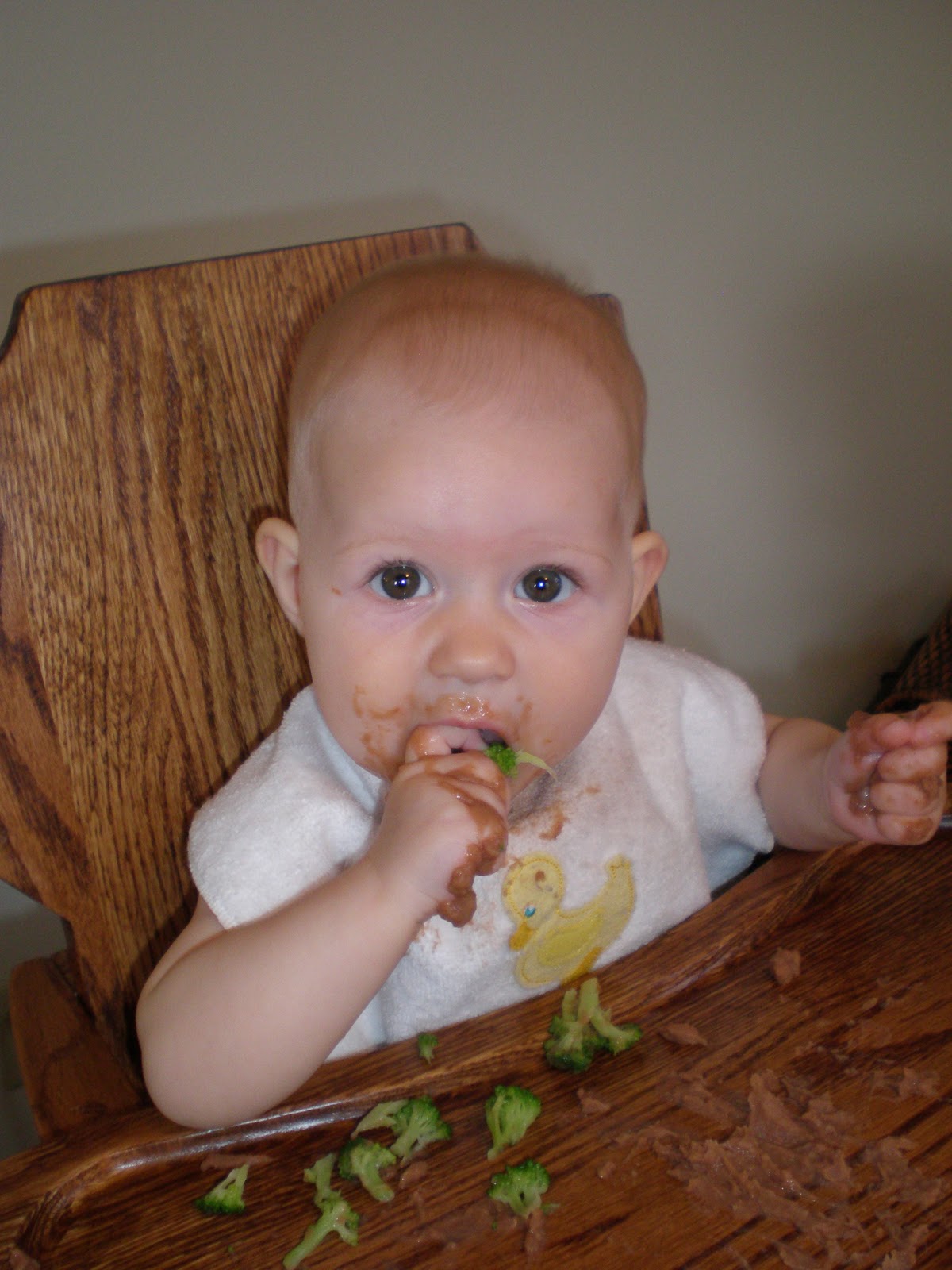
Refried beans


baby eating refried beans
Thinking outside the box is great, when I remember to do it. I don't know why I didn't think of serving refried beans to Buttercup when she was 6-7 months old, as I have discovered it to be a great early baby food. 

I gave her the vegetarian version, which is low in fat (and does not contain lard, unlike the regular version). I've never really understood the name "refried" beans, since this mexican staple hasn't been fried once, let alone twice - they're just mashed pinto beans. Tis a mystery, but I digress.

Buttercup enjoyed this food, though it could partly be because she enjoyed the process of eating them: she scooped up fistfuls and then sucked it off her hand, the dirty little piglet! 

I will keep this in mind as a quick and easy lunch option, since these beans are a good source of protein, manganese, magnesium and fiber. Lots of great bone and muscle-building nutrients! I'll keep a wet washcloth handy, though, as this was messier than our usual BLS fare. Even after a thorough hand-washing, I found it impossible to entirely remove the beany smell from between Buttercup's fingers. 

PRO: good nutrition, easy to eat, easy to prepare
CON: messy

Kale


Just because we aren't spoon-feeding our babies doesn't mean we can't still offer them soup, right? Chunky soups make a great meal option for the self-feeding baby. Just leave out the liquid and give them the soft chunks. In this case we had zuppa toscana on the menu (think 'Olive Garden,' but vegetarian-ified). I drained the liquid and dumped some kale, potatoes, and vegetarian "sausage" onto Buttercup's tray.

I knew she wouldn't have a problem with the potatoes and sausage. It was interesting to watch her eat the kale, though. I never noticed before how stringy kale is! I even got some stuck in the not-quite-up/not-quite-down area of my esophagus. For Buttercup there was a lot of this going on: pick up, chew, spit out, repeat. I was amazed at how persistent she was. She just kept trying to eat those darn leaves. Eventually she succeeded; I just didn't think she would be that motivated to eat something that was putting up such a fight. I guess Buttercup's inner dietician was telling her she needed some vitamin A (hello, 354% RDA!).

PROS: power-packed nutrition
CONS: hard to chew and swallow

Lentils


Lentils are a great solid food for babies! Not only are they easy to eat, but they're chock full of nutrition. Lentils have the most iron of any vegetable, and they are full of other vitamins, minerals and fiber. They're a great substitute for red meat, for those like myself who are withholding red meat from their babes.

I'm sure Buttercup didn't know how good for her these little gems were when she was eating, though it might explain the little 'happy dance' she was doing while eating this meal. I have a recipe for slow cooker lentils that has lots of other veggies and savory goodness. It's one of our family's favorites, and Buttercup concurred.

We noticed a few new developments during this meal. Firstly, Buttercup now only picks up as much in her hand as she can comfortably chew. This means much less spitting food back on the tray. Also, she is getting much better at moving food around with her tongue and chewing it up. She even chews with her mouth closed. Watch out, Miss Manners!

All in all, this will be a great staple to add to Buttercup's diet.

PROS: great nutritional value
CONS: none

Eggplant


Buttercup's global food education continues, this time with french food. On 'le menu du jour': ratatouille. I'd neither eaten nor made ratatouille before, so this was a first for our whole family. Food adventures indeed!

Eggplant was the only ingredient in the dish that was new to Buttercup. It was cut into one-inch squares (with skins on) and cooked down. The consistency of the eggplant was quite nice: a bit meaty, but still easy to squish between a pair of little gums.

It was interesting to see Buttercup maneuver the skins, first using them as handles, then spitting them out when the fruit was gone. Parents may worry about babies choking on skins, but Buttercup never has problems with them - she just spits them out!

Buttercup ate 3 squares of eggplant, along with the other veggies in this meal.

PROS: what's not to like about ratatouille?
CONS: none

Onions


You just never know what foods a baby might like unless you try them! For example, Buttercup likes cooked onions.
She has had finely diced onions mixed in with other foods before, but never larger chunks their own. So, as part of our hawaiian chicken meal, I put some onion strings on her tray.

I was surprised at how much Buttercup ate. She seemed to really enjoy them! She ate them in a similar fashion to the steamed green peppers - she kinda flossed them through her mouth. But, she did eat three or four strings.

In the past I've always considered onion a flavorful filler in foods. But, it turns out they are chock full of goodness. Onions contain natural antibacterial properties, they support the immune system, and they're high in vitamins A & C. Slam dunk!

PROS: nutritious and delicious
CONS: a bit stringy

Rutabaga/Swede


baby eating rutabagaA great thing about using the baby-led solids method is that your baby can take advantage of yummy seasonal produce. The fall-ish weather has inspired me to buy more root vegetables, including one of my favorites from my time living in the United Kingdom: swede (known as rutabaga on this side of the pond). Usually I mash rutabaga/swede and serve it as a side dish, but I made fries out of them one night. I've recently discovered that you can make oven "fries" out of pretty much any root veg - taters, sweet taters, turnips, beets, carrots... These are a healthy alternatives to deep-fried french fries, and are also a great shape for little baby hands! Just make sure you leave off the salt for baby's portion.

Buttercup loved her rutabaga fry and gobbled it all up. Out of curiosity I looked up the nutrition benefits of rutabaga: it is really high in vitamin C and also a handful of minerals. Interestingly enough rutabaga also helps with milk production, so this one is a great option for mommies, too!

PROS: easy shape for BLS
CONS: none